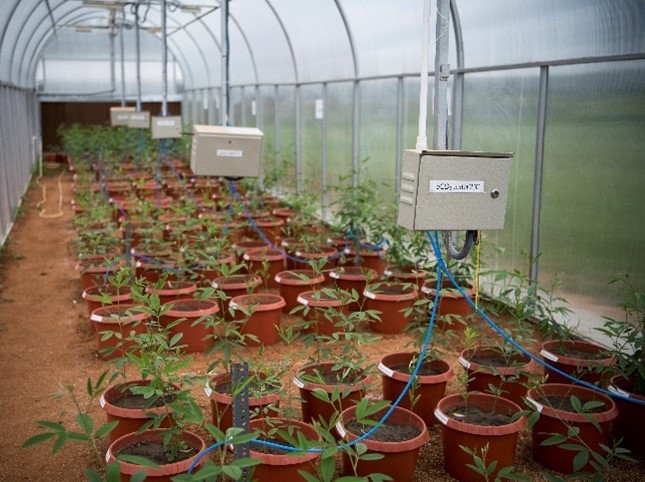

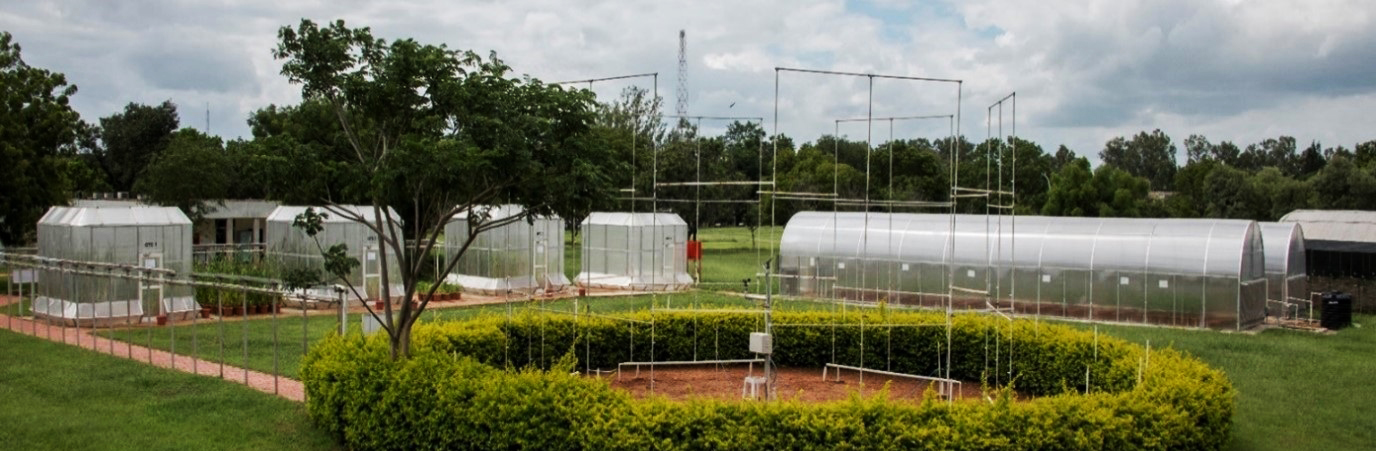
As the planet warms, the impact on global food systems is becoming increasingly evident. State-of- the -art climate change research facility established with the support of Department of Science and Technology (DST), Govt of India is to strengthen the global efforts to alleviate climate change impacts on agriculture and food security. The platform focus is to develop modern crop production and protection tools that can make agriculture more sustainable and climate resilient. Our initiative follows a path of research excellence to harness and mainstream for biotic stress management, crop productivity parameters an nutritional impact essential for national and regional climate adaptation and development plan. The facilities explicitly include Open top Chambers (OTC), Controlled environment temperature gradient tunnels (CTGT) and Free air CO2 enrichment (FACE) equipped to simulate the future climatic conditions (elevated temperature and elevated CO2) and offer a glimpse into a future crop under changing climate . This platform is a is a part of National Mission on Strategic Knowledge for Climate Change. Outcomes from this facility is available for various stakeholders’ scientists and, policy makers to develop country specific adaptation strategies to eventually support the greater resilience of smallholder farmers.
The extreme climate events, increased temperature, and CO2, and narrowing crop diversity primarily responsible for spread and epidemics of plant pests and disease, declining yield and nutritional qulaity. The increasing trends and transboundary outbreak over large geographical regions jeopardizing the food security and have broader economic, social and environmental impacts. Globally, 30-40 per cent crop produce is lost to pest and disease annually and overall losses in attainable yield are far greater in Asia and Africa impacting smallholder farmers’ ability to feed their families.
Accelerated climate change impacts require more attention on a greater scale to protect the livelihoods of poor and most vulnerable regions of the world. Lack of preparedness, inadequate knowledge on pest risks, lack of timely crop protection advice, lack of data on climate cnhage impacts on crop productions parameters, nutritional contents etc hampers the pursuit of Sustainable Development Goals (SDGs). The climate-smart agriculture services need to accelerate in revolutionary ways, and there is need to develop multilateral research models to reduce the climate change impacts by generating evidences and data for future framework for adaptation and mitigation.
The Center of Excellence conducts research, analysis, and disseminates the information which enables:
Distribution and simulation modelling for changing climate on pests & diseases
Efficient strategy to address biotic trait discovery and deployment of resistant lines
Integrated crop health solutions
Early crop stress detection and Decision support systems and impact
A cross cutting solutions to a global problem
Database for historical weather and insect-pests & diseases in India
Epidemiology and forecasting of pests & diseases for value-added agro-advisory vis-à-vis Climatic Change
Mobile Application to provide advisory to enhance the Decision Support System
Prediction of future climate scenarios to map the potential distribution of pests and diseases under future scenarios
Predicting potential distribution of pests and diseases under future climate scenarios
Mapping spatial & temporal distribution of insect-pests & diseases under future climate scenarios
Simulation of climate change variables to study host–insect-pests & diseases interactions to develop adaptation strategies and minimize crop losses
Understanding the impact of elevated CO2 on crop primary production, yiledand crops nutrients (macro and micronutrient)
Capacity building of various stakeholders on suitable plant production and protection and adaptation strategies for climate resilient agriculture
Generate strategic knowledge on preparedness and rapid response services to current and emerging pest & disease threats, changing crop phenology, yield and nutritional quality solicits research-implementation gap and better understanding of climate variability for sustainable food and nutrional security.
The Consortium Approach
Building alliance through multilateral research institutes working group articulated to alleviate the impacts of climate change on agriculture in an inclusive manner with key audience such as Adaptation funding entities, planners, policymakers and practitioners at national and regional level (NARS, ARIs and CGIAR).
Center of Excellence offers
Provides strategic knowledge on pest and disease risks, crop vulnerability and epidemics or outbreak
Conduct studies under simulated climatic conditions in climate change facilities -evaluation of germplasm/cultivars under different temperature and CO2 simulated condition for primary crop response and nutrients accumulation
Characterization of insect-pest and diseases virulence, fecundity, life cycle and infestation at different temperature and CO2 simulated condition
Hands on training and education on climate-smart insect-pest and disease management and climate change adaptations, early warning systems and Decision Support System
Contact Persons
Dr Mamta Sharma
Principal Scientist and Pathology Lead Accelerated Crop Improvement, ICRISAT, Patancheru, 502 324, Telangana, India. Email: mamta.sharma@icrisat.org